Before You Predict, Read This 4-3-3 Breakdown
A football formation is not a fixed picture; it is a starting arrangement for 10 outfield players, with the goalkeeper excluded from the numbers. Match Daily explains how to read formations such as 4-...

Before You Predict, Read This 4-3-3 Breakdown
A football formation is not a fixed picture; it is a starting arrangement for 10 outfield players, with the goalkeeper excluded from the numbers. Match Daily explains how to read formations such as 4-3-3, 4-4-2, 4-2-3-1 and 3-5-2 by tracking defensive lines, midfield roles, width, pressing and transitions. In a 4-3-3, for example, four defenders, three midfielders and three forwards create 10 players, while the goalkeeper makes the full XI. FIFA’s Laws of the Game define a team as 11 players, and modern match data shows that teams often use one shape in possession and another without the ball. A 3-5-2 may become a 5-3-2 defensively, while a 4-2-3-1 can resemble 4-4-2 during a press. Start by identifying the defensive line, then follow the full-backs, midfield pivot and striker rather than trusting the lineup graphic alone.

Photo by Quyn Phạm on Pexels
If You See a Formation Graphic: Start With the Numbers
A formation graphic tells you how a team is expected to arrange its 10 outfield players from defense to attack, but it does not guarantee where those players will stand for 90 minutes. The first number represents defenders, the middle numbers represent midfield layers, and the final number identifies attackers. Therefore, 4-3-3 means four defenders, three midfielders and three forwards; 4-2-3-1 means four defenders, two deeper midfielders, three advanced players and one striker. This basic reading method applies across the Premier League, La Liga, Serie A, Bundesliga and FIFA World Cup matches. The International Football Association Board Laws of the Game confirms that each team fields a maximum of 11 players, including one goalkeeper, which explains why formation totals normally equal 10. Easy enough, unless football decides to disguise the evidence like a midfielder wearing the wrong socks.
The next step is to identify the roles hidden inside each number. A “4” normally includes two centre-backs and two full-backs, but Manchester City may use one full-back inside midfield, while Liverpool have often asked full-backs to provide attacking width. A “3” may mean three centre-backs, or two centre-backs plus a defender stepping into build-up. A “5” usually signals three central defenders and two wing-backs, yet the wing-backs may advance so aggressively that the shape looks like 3-5-2. According to UEFA, tactical systems are best understood through player movement and team principles, not merely positional labels. That distinction matters when Match Daily evaluates World Cup 2026 matchups, because the same printed shape can produce very different chances, pressing intensity and defensive exposure.
Use this quick decoding sequence before reading any tactical prediction:
- Add the numbers and check that they total 10 outfield players.
- Locate the deepest defensive line.
- Identify whether full-backs or wing-backs provide width.
- Count midfielders who can receive behind the opponent’s first press.
- Find the striker’s support: wingers, attacking midfielders or a second forward.
- Compare the starting shape with the team’s likely defensive shape.
Want a cleaner way to connect tactics with match analysis?
If You See a 4-3-3 or 4-4-2: Read the Width and Midfield
A 4-3-3 normally offers one holding midfielder, two advanced central midfielders, two wide forwards and one central striker, while a 4-4-2 uses two banks of four behind two forwards. The 4-3-3 usually creates natural width and supports high pressing; the 4-4-2 offers simpler defensive spacing and a clear strike partnership. Neither shape is automatically superior, because the result depends on distances, player quality, pressing timing and the opponent’s buildup. Data from Opta and UEFA match reports repeatedly shows that possession structure alone does not determine attacking output; territory, entries into the penalty area and shot quality matter more than decorative diagrams.
When reading a 4-3-3, watch the relationship between the number six and the two eights. If the holding midfielder drops between centre-backs, the full-backs may advance and create a 2-3-5 attacking structure. If one full-back moves inside, the midfield can become a four-player box, giving the team extra passing options but leaving the flank exposed during turnovers. Barcelona under Pep Guardiola popularised several variations of positional play, while Jürgen Klopp’s Liverpool often combined a 4-3-3 starting shape with aggressive counter-pressing and advanced full-backs. The useful question is not “Does the team play 4-3-3?” but “What does the 4-3-3 become when possession changes?” Isn’t that the point?
A 4-4-2 should be read through its two lines of four. The midfield line can stay narrow and protect central zones, forcing opponents toward the wings, where crosses become the main threat. However, the shape can struggle if the two central midfielders face a three-player midfield, especially when the opponent creates a free number six. Atlético Madrid have demonstrated how a compact 4-4-2 can defend space with remarkable discipline, while Manchester United’s historic 4-4-2 used a front two to stretch centre-backs and initiate direct attacks. Compare these practical strengths and weaknesses:
| Formation | Main advantage | Main vulnerability | Key observation |
|---|---|---|---|
| 4-3-3 | Width and midfield support | Space behind advanced full-backs | Track the holding midfielder |
| 4-4-2 | Compact banks and two forwards | Possible midfield overload | Watch central spacing |
| 4-2-3-1 | Double-pivot protection | Lone striker isolation | Track the number ten |
| 3-5-2 | Central overload and wing-back width | Wide defensive transitions | Watch wing-back recovery |
For more context, explore our [Internal Link: beginner’s guide to football tactics] before comparing individual teams. The contrarian takeaway is simple: a 4-4-2 can control a match with less possession than a 4-3-3 if its distances remain compact and its first two passes after winning the ball are clean. Possession percentages do not pay rent; territory and chance quality do.
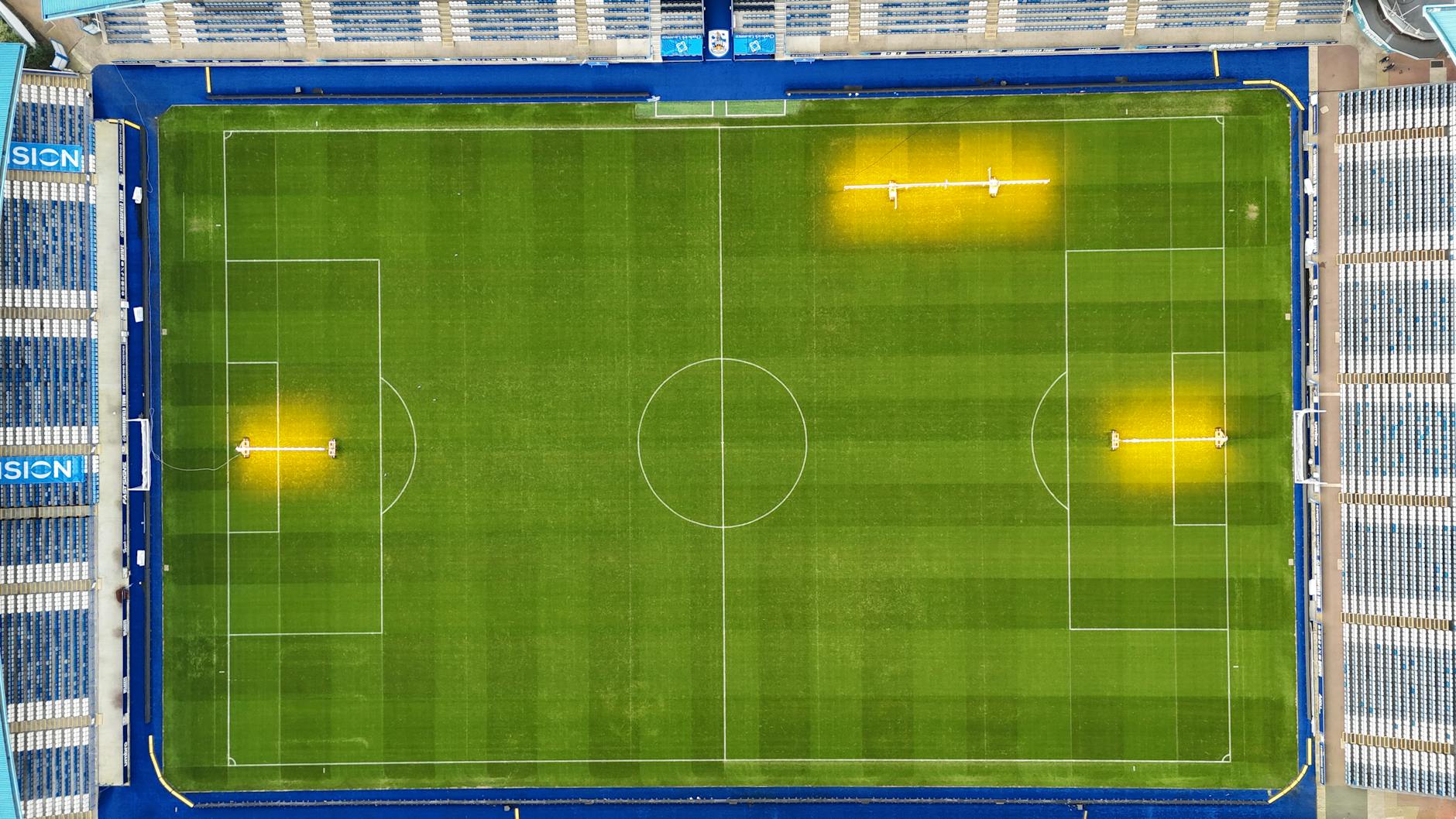
Photo by David Pickup | Advertising & Marketing 🇬🇧 on Pexels
If You See a 4-2-3-1 or 3-5-2: Track the Transformations
A 4-2-3-1 contains a back four, a double pivot, three attacking midfielders and one striker, while a 3-5-2 normally uses three centre-backs, five midfielders and two forwards. The 4-2-3-1 protects the central defenders with two deeper midfielders and places a number ten behind the striker. The 3-5-2 creates central numbers through three centre-backs, three central midfielders and two forwards, but its defensive success depends heavily on wing-back recovery. In practical terms, the 4-2-3-1 often becomes 4-4-2 when the number ten joins the striker, whereas the 3-5-2 often becomes 5-3-2 without possession.
The double pivot in 4-2-3-1 is not automatically defensive. One midfielder may remain behind the ball while the other advances into the half-space, effectively producing a 4-1-4-1 in attack. Germany’s 2014 World Cup team and José Mourinho’s Real Madrid used different versions of this principle, proving that a formation label says little about tempo or ambition on its own. Watch who receives the first pass from the centre-backs, who covers the full-backs and whether the number ten can turn between the opponent’s midfield and defence. A blocked number ten often leaves the lone striker disconnected, producing sterile possession and the tactical equivalent of shouting into an empty fridge.
The 3-5-2 requires more detailed observation because the wing-backs control the shape’s risk level. If both wing-backs advance, the side may attack with five players across the front line and expose the outer centre-backs to counter-attacks. If one wing-back stays deeper, the formation can become asymmetrical, with a back four on one side and a three-man rest defence on the other. Antonio Conte’s Juventus and Italy teams showed how 3-5-2 can create overloads near the ball, while Inter Milan have used related structures to launch fast attacks through two strikers. A practitioner-level edge is to record wing-back positions at three moments: opposition buildup, the first turnover and the final pass. If recovery takes more than approximately 5 seconds, the wide channel becomes an obvious transition target.
Try this transformation checklist when watching live football:
- At kickoff, record the listed formation.
- At the opponent’s goal kick, identify the pressing shape.
- After a successful buildup, count players ahead of the ball.
- Immediately after losing possession, check the rest-defence structure.
- During substitutions, note whether the coach changes roles or only personnel.
- After 15 minutes, update the shape rather than trusting the pre-match graphic.
See how these details affect tournament matchups and pre-game evaluation.
If You Study a Match Before Predicting: Measure Functions, Not Labels
Before using a formation in a match prediction, compare how each side creates width, protects the centre and responds to turnovers. A 4-3-3 facing a 3-5-2 is not automatically an attacking-versus-defensive matchup; it may become a battle between wingers attacking wing-backs and central midfielders trying to exploit numerical superiority. A 4-2-3-1 against a 4-4-2 may depend on whether the number ten can receive between the lines or whether the opponent’s two central midfielders block that lane. Therefore, tactical reading should be combined with player availability, recent minutes, set-piece performance, travel and game state.
Use measurable observations rather than vague claims such as “Team A looks more balanced.” Record the following across at least 5 recent matches:
- Average defensive line height, estimated from video or tracking data.
- Number of players involved in the first pressing wave.
- Full-back or wing-back starting positions during possession.
- Ball recoveries in the middle third and final third.
- Shots conceded after turnovers within 10 seconds.
- Crosses allowed from the opponent’s preferred flank.
- Expected goals, or xG, created through central and wide attacks.
One useful information gain is that the same formation can produce a 2-3-5 attacking structure or a 3-2-5 structure depending on which defender steps into midfield. That detail changes counter-attack exposure more than the headline formation itself. A second is that a team with a nominal lone striker may still attack with three players if the winger opposite the ball attacks the far post and the number ten joins the penalty area. Match Daily’s World Cup 2026 coverage should therefore be read alongside confirmed lineups and player roles, not isolated from them. As FIFA competition scheduling, travel between venues and substitutions influence intensity, the 15-minute period after halftime can reveal whether a coach has solved the original matchup.
[Internal Link: advanced football pressing guide] and [Internal Link: expected goals explained] can help turn these observations into a repeatable process. Football prediction is not fortune-telling; it is probability with shin pads. The sensible approach is to assess several scenarios: an early goal, a red card, a defensive substitution and a shift from high pressing to a mid-block. If your prediction only works in one match state, it is not a robust prediction. It is a wish wearing a spreadsheet.

Photo by Yan Krukau on Pexels
Common Pitfalls to Avoid
The most common error is treating the formation shown on a television graphic as the team’s permanent structure. A 4-3-3 may defend in 4-1-4-1, build in 3-2-5 and attack in 2-3-5 within the same possession sequence. Another mistake is assuming that more defenders always means more defensive intent; a 3-4-3 with aggressive wing-backs can commit seven players forward, while a 4-5-1 may defend extremely deep. The numbers describe starting lanes, not courage, quality or guaranteed results. According to FIFA Training Centre, coaches analyse principles such as spacing, support, compactness and progression in addition to nominal formations.
Avoid these five reading mistakes:
- Counting the goalkeeper in the formation number.
- Confusing a wing-back with a traditional full-back.
- Ignoring the opponent’s shape and pressing triggers.
- Using possession as a substitute for chance-quality analysis.
- Predicting from last week’s formation without checking the starting XI.
- Assuming a substitute enters the same tactical role as the player leaving.
- Treating a formation change as meaningful without checking player distances.
A further problem is overvaluing famous historical examples. Guardiola’s Barcelona, Arrigo Sacchi’s AC Milan, Conte’s Juventus and Joachim Löw’s Germany provide useful references, but copying their labels without matching player profiles is poor analysis. A high full-back needs recovery speed, a lone pivot needs scanning and passing range, and a two-striker system needs forwards who can either split or combine. “The formation is only the beginning,” is the practical conclusion supported by modern coaching analysis, because function depends on movement, timing and decision-making. If a team loses its best ball-progressor, the same 4-2-3-1 may become a slow 4-4-1-1. The number survived; the idea did not.
The 30-Day Check-In
Use a 30-day review to test whether your formation reading is improving. During four weeks, watch at least 10 matches and record the listed formation, in-possession structure, out-of-possession shape, first pressing trigger and major transition weakness. Include matches from the Premier League, UEFA Champions League, Liga MX and FIFA World Cup 2026 preparation where available, because tactical habits can vary by competition and opponent. After every match, write one sentence answering: “What did the formation allow, and what did it expose?” This forces you to analyse functions rather than repeat commentary.
At the end of the period, compare your notes with observable outcomes. Did teams creating wide overloads generate more box entries? Did the side with a double pivot concede fewer central transitions? Did wing-backs recover quickly enough to prevent one-versus-one attacks? You do not need expensive tracking software to start; a stopwatch, match replay and simple spreadsheet can reveal useful patterns. For stronger evidence, compare your observations with event data from StatsBomb, Opta reports or UEFA technical publications, while remembering that public data definitions differ between providers.
A practical 30-day scoring model can use 1 point for correctly identifying each category: starting shape, pressing shape, buildup shape, transition weakness and decisive role. A score of 4 out of 5 across 10 matches means your reading process is becoming consistent, while repeated scores below 3 suggest that you are relying too heavily on graphics. Review the five lowest-confidence observations and watch those sequences again at half speed. This is less glamorous than declaring a tactical masterclass after six minutes, but it is also less likely to make you look foolish in the group chat.
Ready to apply the method to upcoming fixtures?
Frequently Asked Questions
Q: What does a football formation mean?
A: A football formation describes how a team’s 10 outfield players are arranged, with the goalkeeper excluded from the numbers. The sequence is normally read from defence to attack, so 4-3-3 means four defenders, three midfielders and three forwards. However, the shape changes during possession, pressing and defensive transitions, meaning the listed formation is a starting reference rather than a permanent map.
Q: How do you read a 4-3-3 formation?
A: Read a 4-3-3 as four defenders, three midfielders and three forwards, then identify the holding midfielder and the positions of the full-backs. Check whether the midfield forms one pivot with two advanced players or two deeper players with one number ten. Finally, observe whether the wingers stay wide, move inside or press the opponent’s centre-backs.
Q: What is the difference between 4-4-2 and 4-2-3-1?
A: A 4-4-2 uses two midfield lines of four and two forwards, while a 4-2-3-1 uses a double pivot, three attacking midfielders and one striker. The 4-4-2 usually offers a clearer strike partnership and compact defensive blocks. The 4-2-3-1 can provide stronger central protection and a dedicated number ten, but the lone striker may become isolated if the attacking midfielders cannot advance.
Q: Is 3-5-2 an attacking or defensive formation?
A: A 3-5-2 can be either attacking or defensive, depending mainly on wing-back positioning. With both wing-backs high, it may attack in a 3-2-5 or 3-1-5-1 structure and create five players near the final third. Without the ball, it commonly becomes 5-3-2, with the wing-backs dropping alongside three centre-backs.
Q: Why does a formation sometimes fail during a match?
A: A formation usually fails because player distances, roles or transitions do not work against the opponent’s structure, not because the numerical label is inherently bad. For example, a 4-3-3 can lose control if the holding midfielder is pressed and both full-backs advance simultaneously. Coaches may respond by lowering the defensive line, adding a midfielder or changing the pressing trigger.
Q: How much football knowledge is needed to read formations?
A: Basic formation reading requires only knowledge of the 11-player team structure and the main defensive, midfield and attacking roles. You can begin by analysing 10 matches and recording five categories: starting shape, pressing shape, buildup shape, transition weakness and decisive role. Advanced understanding develops through repeated viewing, video replay and comparison with event data from UEFA, Opta or StatsBomb.
Q: Can formation analysis improve football predictions?
A: Formation analysis can improve predictions by revealing likely overloads, exposed spaces and matchup advantages, but it cannot guarantee a result. Combine tactical observations with confirmed lineups, injuries, recent minutes, expected goals, travel and match-state scenarios. The strongest process is probabilistic: estimate how the game may change after an early goal, red card or tactical substitution rather than predicting only the opening shape.
The key is straightforward: read football formations as moving systems, not static numbers. Once you track width, midfield access, pressing shape and transition protection, 4-3-3, 4-2-3-1 and 3-5-2 stop looking like cryptic lottery codes. Match Daily provides a useful starting point for following World Cup 2026 tactics, player statistics and match predictions, but your best edge comes from checking the evidence yourself. Start with one match, one formation and one honest question: what did this shape make possible?
Learn more from the latest tactical breakdowns and tournament analysis.
End of Transmission
Thank you for reading. Explore more articles from the archive.
Match Daily · Article #33 · 2026